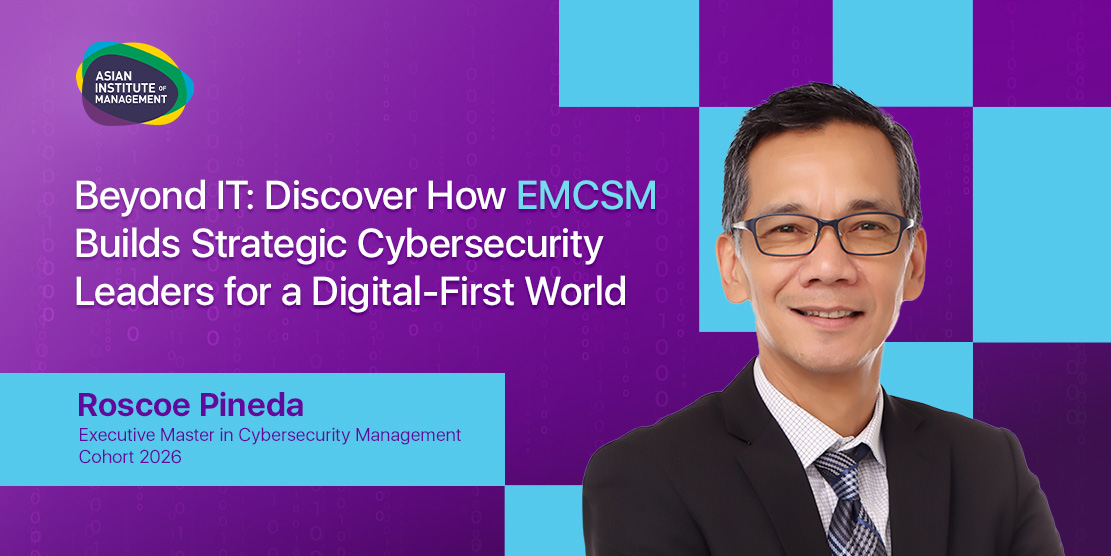
Beyond IT: Discover How EMCSM Builds Strategic Cybersecurity Leaders for a Digital-First World
As organizations navigate an increasingly complex digital landscape, cybersecurity has become a critical component of business strategy. Beyond protecting systems and data, it now influences enterprise governance, regulatory compliance, operational resilience, and stakeholder trust. Addressing these challenges requires leaders who can integrate cybersecurity into executive decision-making and organizational strategy.
The Executive Master in Cybersecurity Management (EMCSM) at the Asian Institute of Management (AIM) empowers professionals to lead at this intersection. Through an interdisciplinary curriculum that combines cybersecurity, governance, leadership, and applied research, the program equips executives with the knowledge and perspective to address evolving cyber risks while advancing business objectives.
For Roscoe Pineda, an EMCSM alumnus and Vice President and Chief Information Officer of one of the Philippines’ largest real estate and property developers, the program delivered advanced cybersecurity courses, offering an opportunity to strengthen his strategic perspective and apply it to the increasingly complex demands of executive cybersecurity leadership.
From Technology Expert to Strategic Business Leader
With more than 33 years of experience in information technology, Roscoe has built a career spanning software development, shared services, and executive leadership across multinational and captive service organizations. Throughout his professional journey, he has witnessed the growing convergence of technology, governance, and business strategy.
Today, as Chief Information Officer, he leads enterprise technology initiatives while overseeing information security and data privacy. As these responsibilities continued to expand, he recognized the importance of complementing industry experience with structured academic learning that could provide fresh insights into emerging challenges and evolving best practices.
The EMCSM program offered that opportunity. Over the course of 18 months, Roscoe developed essential skills for cybersecurity leadership and deepened his understanding of cybersecurity governance, regulatory frameworks, information security, digital forensics, network security, financial management, project management, and applied research. Additionally, through case-based learning and collaboration with fellow executives, the advanced program encouraged participants to examine complex issues from multiple perspectives and develop practical, business-driven solutions.
Championing Practical Solutions Through Applied Research
A defining component of the EMCSM program is its emphasis on applied research that addresses pressing organizational and industry needs.
For his capstone project, Roscoe and his team developed Serbisyong CISO, a proposed “Chief Information Security Officer as a Service” model designed to improve access to cybersecurity leadership for micro, small, and medium enterprises (MSMEs) and public institutions.
This research responds to a significant gap in the Philippine cybersecurity landscape. While organizations are expected to comply with the Data Privacy Act of 2012 and strengthen their cybersecurity posture, many smaller organizations lack the resources to establish dedicated cybersecurity leadership or sustain enterprise-level security programs.
Rather than adapting solutions designed for large corporations, Serbisyong CISO proposes a model tailored to the realities of MSMEs. By providing access to strategic cybersecurity guidance, the initiative seeks to help organizations strengthen governance, improve security awareness, and support regulatory compliance in a more accessible and inclusive manner.
Learning from Diverse Executive Perspectives
Beyond the caseroom, the EMCSM experience was enriched by collaboration with professionals from a wide range of industries, including healthcare, financial services, telecommunications, government, and law enforcement.
These diverse perspectives reinforced a common understanding that cybersecurity extends beyond protecting digital infrastructure. Whether safeguarding sensitive health information, securing financial transactions, or protecting critical national systems, participants recognized that effective cybersecurity leadership requires collaboration across functions and sectors.
The exchange of experiences challenged participants to think beyond their respective industries and develop solutions that address increasingly interconnected risks.
Preparing Executives to Lead the Future of Cybersecurity
Roscoe’s academic journey at AIM reflects the growing need for leaders who can bridge technology and business strategy in an era of rapid digital transformation. As the cybersecurity landscape continues to evolve, professionals with expertise across technology, governance, and business strategy are increasingly well positioned for a broad range of cybersecurity jobs.
Furthermore, as organizations continue to adopt artificial intelligence, cloud technologies, and other emerging technology, executives must be prepared to make informed decisions that strengthen digital resilience while supporting sustainable business growth.
Through its integration of executive education, applied research, and cross-sector collaboration, the Executive Master in Cybersecurity Management at the Asian Institute of Management prepares professionals to lead cybersecurity as a strategic business capability—empowering organizations to navigate complexity, build trust, and thrive in an increasingly digital economy.
Ready to join a community of cybersecurity leaders? Explore the Executive Master in Cybersecurity Management at AIM today.