
Leading When There Is No Playbook: Lessons from Industry Leaders Who Made It
The most consequential leadership decisions rarely come with clear instructions. They emerge in moments of uncertainty—when risks are difficult to predict, opportunities require action before all the answers are known, and the choices made can shape what comes next.
For leaders across banking, entrepreneurship, and public service, navigating uncertainty has meant making decisions before the full picture comes into view. Experience may sharpen instinct, but preparation, humility, and courage to act enable leaders to navigate complexity and chart the way forward.
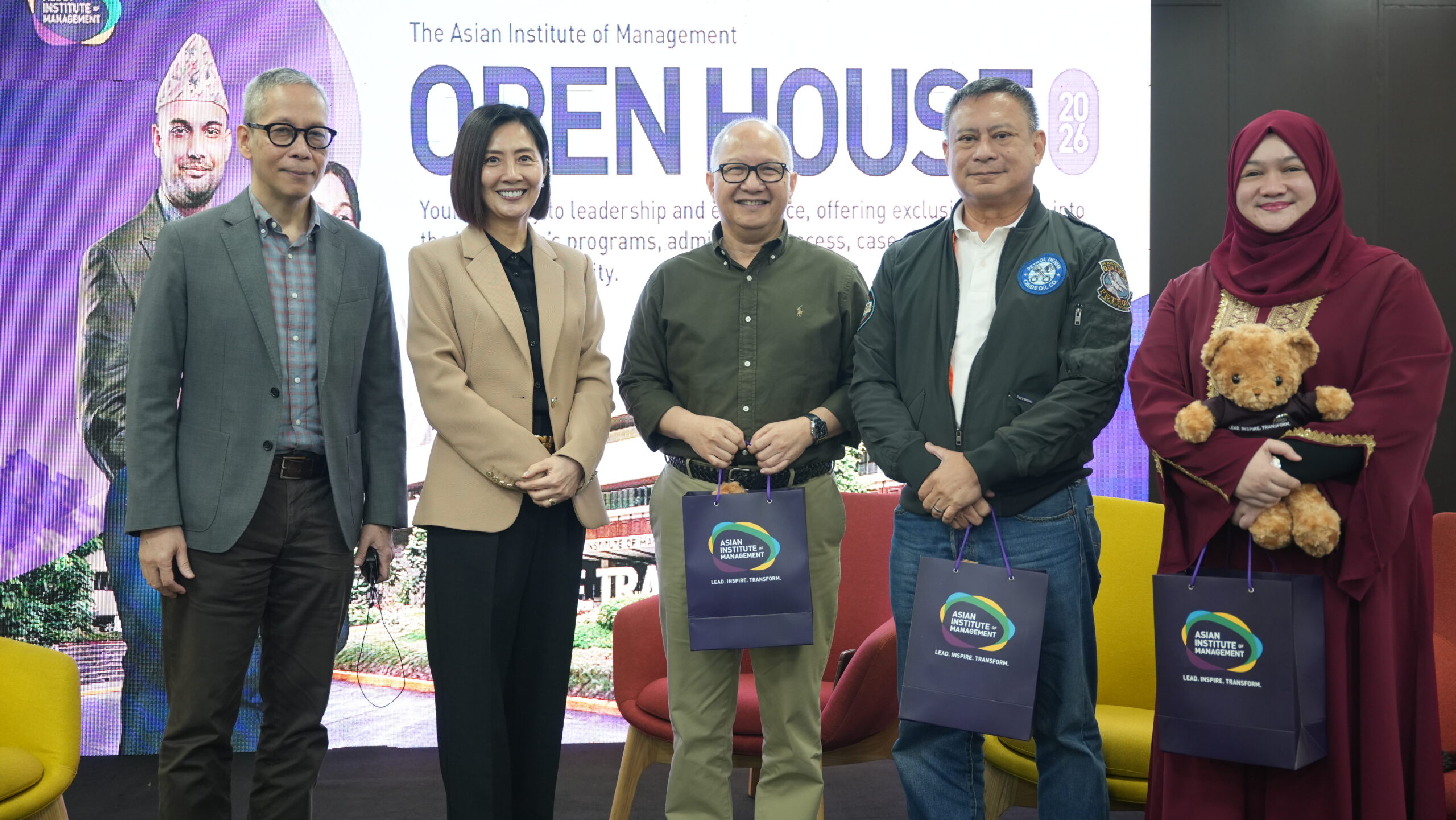
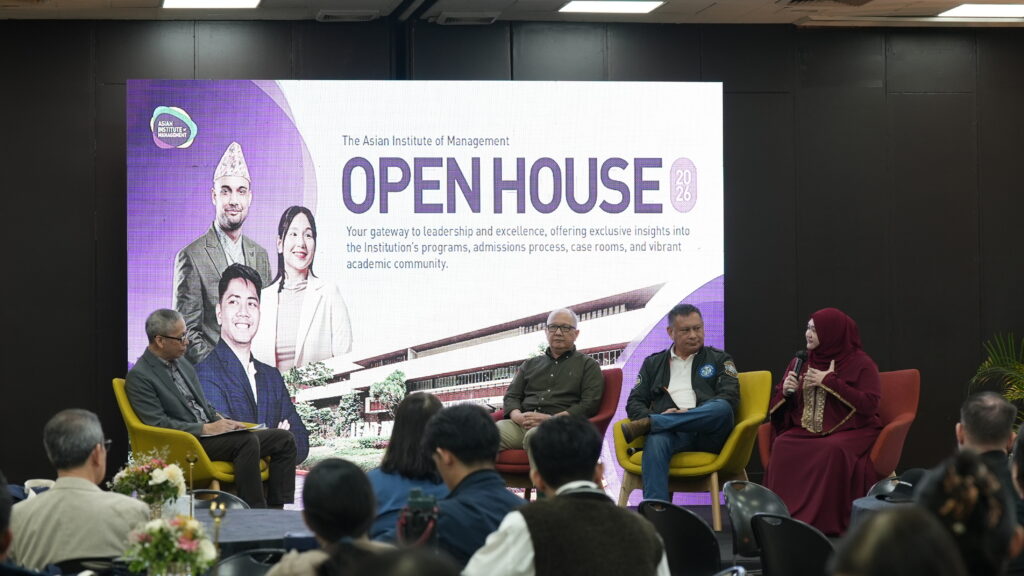
This was the thread that connected the conversation at the Asian Institute of Management (AIM) Open House 2026, where three AIM alumni—Dr. Eugene Acevedo, former President and CEO of Rizal Commercial Bank Corporation (RCBC); Jose Magsaysay Jr., co-founder and former CEO of Potato Corner; and Nur-Ainee Tan Lim, Deputy Minister of the Ministry of Social Services and Development of the Bangsamoro Autonomous Region in Muslim Mindanao (BARMM)—shared lessons and perspectives shaped by distinct leadership journeys.
Prepare First, Clarity Follows
Acevedo’s approach is straightforward: be ready before the moment demands it.
“You need to prepare yourself as leaders because thousands of people or hundreds of people are dependent on your decisions. You cannot just say, hmm, what’s my gut feel? That doesn’t work,” Acevedo noted. “The second is you will never learn everything, but you better make sure that your company knows more than your competition. You don’t have to be perfect. You just have to know much better than everybody else. Third, you have to start moving because it is only through movement when you get a little bit more clarity.”
After earning his Master in Business Management, now Master in Business Administration (MBA), in 1987, Acevedo returned decades later to pursue an Executive Doctor of Business Administration (DBA), a reflection of the value he places on continuous learning.
Yet for all the technological and digital shifts he has witnessed throughout his career, he believes the fundamentals of leadership remain remarkably stable.
“The leaders who built relationships with their people, the leaders who communicated what needed to be done and asked how people felt about the problem—in other words, the leaders who were credible and trustworthy, were the leaders who were successful,” he emphasized. “The most important things will never change. Leaders have to be credible wherever they bring their organization.”
Don’t Wait for the Perfect Moment
Magsaysay’s journey began with a different kind of preparation: learning by doing.
When he started Potato Corner in 1992, he was an employee at a fast-food chain with no formal training in entrepreneurship. Years later, his Master in Entrepreneurship gave structure to the instincts that had driven him from the start.
“It gave me a system. The way I was thinking became different. There is a discipline in how you think, how you start things. There is a process,” Magsaysay said.
That discipline sharpened the way he approached challenges, giving him the flexibility to find a way forward even when the obvious route was unavailable. “Because we learned from the challenges that you cannot enter some places with what you have. That’s not going to stop me,” he explained. “One of our professors kept on saying that if I cannot find a way through you, I will find a way around you, above you, and below you. That’s the mantra.”
Moreover, for Magsaysay, waiting for perfect conditions can mean missing the opportunity altogether.
“If we waited for the perfect time to start Potato Corner, there’ll be no Potato Corner today,” he stated.
Put People Before the Numbers
For Tan Lim, the meaning of leadership becomes most apparent when decisions carry consequences beyond the organization itself.
As Deputy Minister of the Ministry of Social Services and Development in BARMM, she works across policy, development, and crisis response, areas where decisions can have immediate consequences for communities.
“People are not mere statistics,” Tan Lim highlighted. “No matter how large of a scale a program or a disaster is, you always have to humanize your decisions. You need to also have the technical competency to be graceful under pressure. Because if you’re graceful under pressure, then you have some sense of clarity where you can be empathic without being drowned by your emotions.”
Her approach to leadership was also shaped early by the people who challenged her to look beyond prescribed answers and interrogate the realities behind them.
“Our professors were not just teachers. They were mentors,” Tan Lim said. “They taught us how to think in our context, in our circumstance.”
That balance becomes even more consequential as technology takes on an expanding share of the work. Asked what skills leaders will need as AI becomes more capable, Tan Lim pointed to something technology cannot provide on its own: judgment.
“The skills that you require would be decision-making skills, problem-solving skills, because AI can give you the options, but it will never decide for you,” she said. “It will give you alternatives, but it will never say which one is best because you know your circumstances.”
And while AI may outperform people in speed and volume, the Master in Development Management alumni see this as precisely why human capabilities matter more, not less. As she put it, “AI cannot compete with our humanity. So, we work on that.”
Leading the Way Forward
The journeys of Acevedo, Magsaysay, and Tan Lim to leadership were anything but identical. What connects them is not a shared formula for success, but a willingness to keep learning, make difficult choices, and move forward when the next step was not always obvious.
Their experiences suggest that leadership is not earned by following a prescribed route. It is built through the decisions made along the way—and the ability to take responsibility for where those decisions lead.
When there is no playbook, the path forward is ultimately shaped by the leader willing to define it.