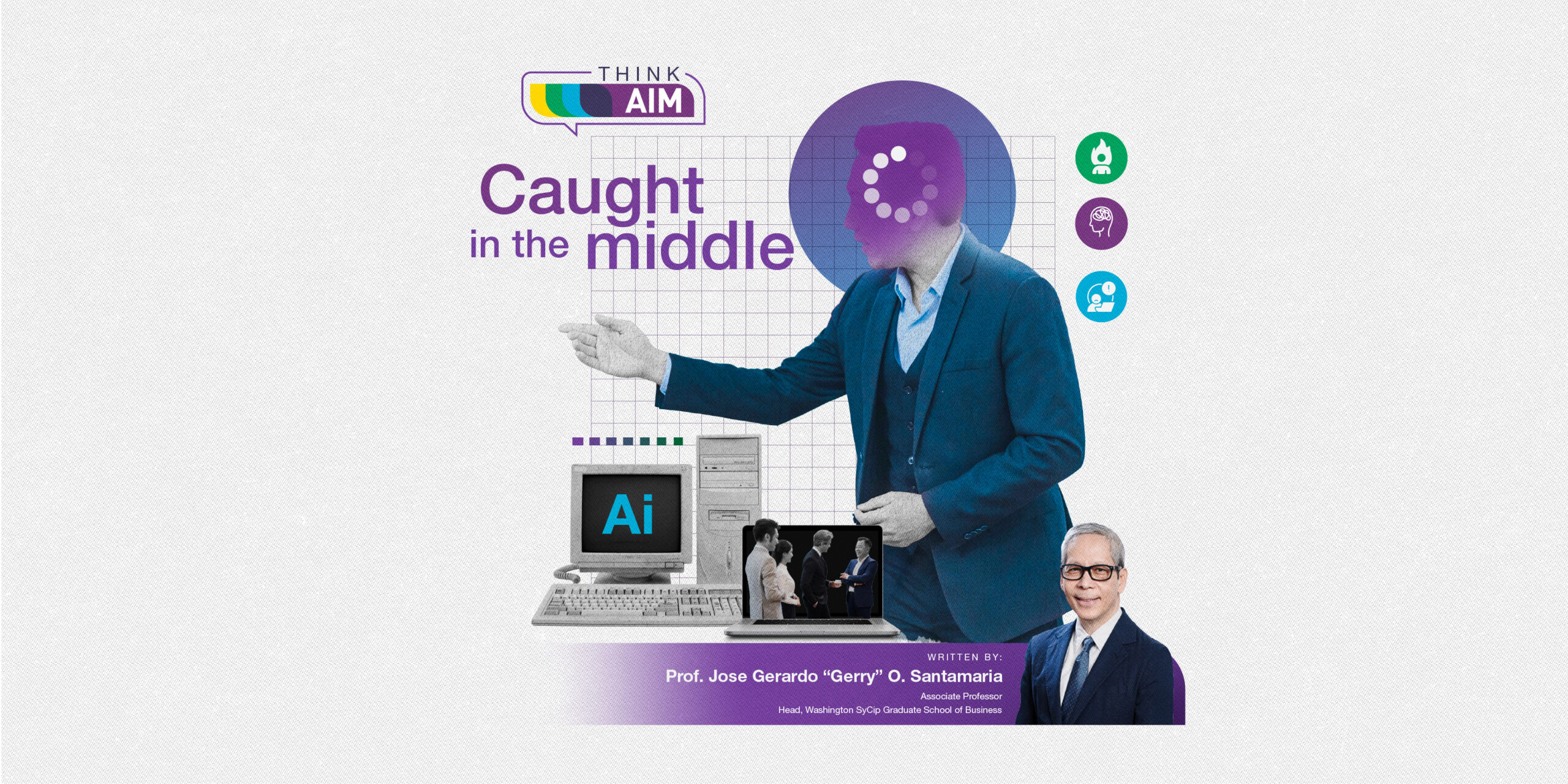
Caught in the middle
By Professor Jose Gerardo “Gerry” O. Santamaria
*As seen in inquirer.net
MANILA, Philippines — Middle managers matter in organizations.
Their ability to help employees understand what needs to be done is critical to the successful implementation of a company’s strategy in today’s Vuca (volatile, uncertain, complex, ambiguous) environment.
Managers affect employee engagement and retention, two important metrics that an organization tracks to manage its most important assets.
However, according to a recent Gallup report, the largest decline in global employee engagement in 2024 was among managers. Middle managers are experiencing an unfortunate squeeze.
Technology disruptions
Organizations are facing a myriad of challenges—technology disruptions, with artificial intelligence (AI) as the major driver; market volatility, such as pandemics and geopolitics; climate change; and changing customer expectations—that have converged to make survival, let alone succeeding, in the marketplace more difficult.
As such, organizations need to innovate, continuously to distinguish themselves from the competition; organizations need to reinvent and undergo changes not just to keep pace but to thrive in a market that rewards speed and adaptability.
Ever since the pandemic, organizations have leveraged new technologies to become more efficient and effective in their processes. Organizations have undertaken digital transformations and reconfigured their strategies and cultures.
Work pressure
They are deploying AI to automate repetitive tasks, gain new insights to improve their decision-making, enhance customer service and innovate products and services.
Organizations need to undertake these initiatives that are vital to their survival, but unfortunately, contribute to the work pressure that employees are experiencing.
Digital transformations often require workers to unlearn what they had previously been experts in, develop new skills and learn new processes to keep abreast of the new requirements of their work.
While workers rate innovation positively, they are more likely to speak negatively about work-life balance and a manageable workload.
Burnout
Most workers in Asia may be prone to overwork anyway, given cultural practices of high-power distance and collectivism that may prevent them from questioning work demands and, instead, conforming to the status quo.
Two separate surveys conducted in late 2022 showed that workers in the Philippines reported the largest prevalence of burnout, driven by a moderate to high risk of mental health issues, the highest in Southeast Asia.
Workers are physically and mentally exhausted. To cope with higher work demands, workers end up compensating by calling in sick more often, reducing effort at work or resigning.
They will not perform citizenship behaviors that are crucial to the effective functioning of an organization. These are the same workers that managers need to motivate so that the organization’s strategies will be implemented according to plan.
This is the situation that managers find themselves in, the pressure from above and the growing disengagement of workers they need to manage.
Disengagement
It is no wonder that they, too, have been experiencing burnout and are themselves exhibiting disengagement.
Research has shown that burnout leads to negative outcomes for the individual and the organization.
Consequences of burnout include sleep problems, headaches and impairment of immune systems, as well as increased absenteeism and turnover intentions and decreased job performance.
How can managers be expected to perform at consistently high levels when they are faced with such challenges at work?
Organizations cannot thrive in the Vuca environment without taking care of the people who implement their strategies.
They can support managers by communicating to them the rationale for the changes, helping them understand the value of initiatives for survival.
‘Quiet time’
They should define priorities so managers are not overwhelmed with numerous tasks that need to be accomplished. When possible, they could include the managers in designing, if not allowing them to determine how to implement, the initiatives.
They can be smart about meetings, scheduling these in blocks instead of having them throughout the day. This will provide managers “quiet time” when they can work on what they need to.
They should also acknowledge the difficulties that they are going through and build a climate of psychological safety, where they can openly speak up about concerns.
Managers can be supported through coaching to help them manage resistance to change and well-being. Senior leaders can show empathy and be accessible to them; checking in on managers’ well-being and showing appreciation for the work done can help strengthen community.
When possible, they can provide managers with extended rest periods. Studies have shown that interventions focused on the individual, such as helping them manage stress better and to build personal resources such as increasing self-efficacy, resilience, and optimism, to be effective in buffering the deleterious effects of work demands.
While the sources of work demands cannot be fully addressed by organizations, these interventions may provide the much-needed support for managers and all workers.